
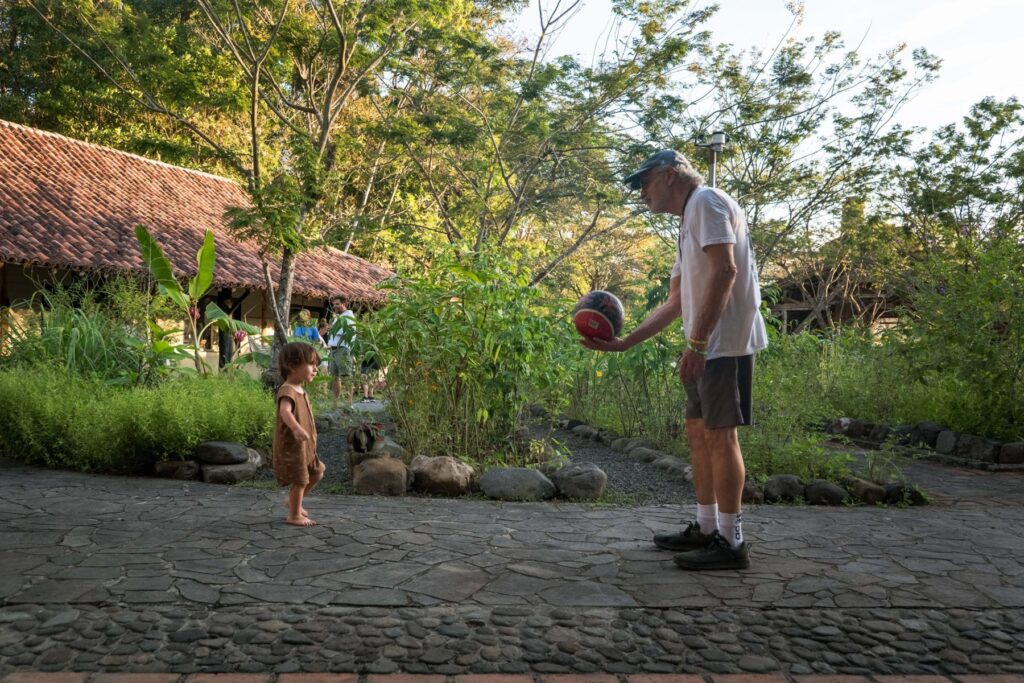
In our intentional communities in Costa Rica, several families live with three generations close together: grandparents, their children and their grandchildren. Not every household looks like that, but senior residents are an active and valued part of community life.
In this video, two of our neighbours in La Ecovilla Original, Sue and Yves, share how they found their way here and what life in community is like for them. Sue and her family will soon start building their new home in our second community, Ecovilla San Mateo.
What does multigenerational living look like here?
For the families who live here across generations, it often means grandparents living a few steps away from their children and grandchildren, each in their own home. The children spend their days outdoors with their friends. As Sue puts it: “You don’t see them from one meal to the next. They’ll come back when they’re hungry.”
Sue and Yves each show a different side of it. Sue lives right next to her daughter’s family and is part of her grandsons’ everyday lives. Yves followed his adult daughter to Costa Rica and sees her almost every day, while building a full life of his own here. What they share is the feeling that senior residents are valued, with their own friendships, routines and a voice in the community.
Curious about everyday life in the community? Read more in Living in Ecovilla.
Sue’s story: from life at sea to the jungle
Sue grew up on Jersey, a small island in the Channel Islands between England and France, about 14 km wide and 8 km long (9 by 5 miles). She lived there very happily, surrounded by friends and family.
When the world started going a little topsy-turvy around 2020, Sue and her family began questioning their freedoms. One day her son-in-law suggested they all sell their houses, buy a boat and find their freedom again. “Wow, why not?” It didn’t take long for everyone to agree that it could be an exciting plan.
They spent almost three years on the open sea. Then they decided it was time to settle somewhere, mostly for the sake of the boys, so they could build solid relationships with friends their own age.
Water, food, shelter and community: why Sue’s family chose La Ecovilla
Sue’s daughter spotted the community on Instagram. With all the turbulence in the world, the family had become very aware that four things are essential to life: water, food, shelter and community.
“And it seemed that La Ecovilla was able to supply those four essential things very, very well,” Sue says. Today she sees it in her daily life: fresh vegetables from the community garden every week, a home of her own, and neighbours who are always ready to help.
Living close to family, with your own front door
The family found a beautiful house. Sue’s daughter and her family live in the big house at the bottom of a little slope, and Sue has her own casita just above it. “So, although we’re still together, we each have our own front doors and it all works very well.” The family will soon start building their own home in Ecovilla San Mateo, the second community of La Ecovilla.
That balance matters. Sue is close enough to be part of her grandson’s everyday lives, and still has her own space. “I feel very blessed to be able to spend so much time with them.”
A week in Sue’s life
On Saturdays, each home receives a basket of freshly grown vegetables and herbs from our community garden. Sue helps fill all of them: 30 to 40 baskets every Saturday morning.
During the week she helps out with the boys and does a lot of the school runs. She also sews a lot: she makes and mends clothes, and creates beautiful cushions and accessories. The rest of her time goes to meeting people. “You don’t have to go very far from your home to bump into someone who’s also out for a walk and also wants a chat. And everybody’s here to help each other out.”
After years at sea, it was a huge change: exchanging the blue for the green, and the dolphins for monkeys leaping on the roofs. Still, the whole family is settling in very well, and Sue knows the main reason: the community.
Why senior residents feel valued in community
“People of my generation start to become invisible, start to become pushed to one side,” Sue says. “Here we are embraced. We are valued. Our opinions are valued.”
To be perfectly honest, she says, it took her a while to get used to that, because it was no longer what was happening in her life before.
The first time someone called her a crone, her reaction was: “Crone? Me?” Then she thought about it more deeply. Looking back in history, crones were very much valued in their communities. “And here I am, a crone.”
Yves’ story: a new chapter after retirement
Yves is from Montreal, Canada. He worked as a police officer for 30 years and has been retired for 10. His daughter lives and works here, so Yves came to visit. Then he came again, and again. At some point, for a reason he can’t explain, he fell in love with the country. Being here felt like home.
That was confusing at first. “I never thought in my life that I would move out of my country.” But he loved the community: the way people live, the way they act and how welcoming they are. “So I said, ‘Wow, I want to be part of it.'”
Neighbours who become friends
“I have never been as close with my neighbours as I am here,” Yves says. In Canada, people usually don’t talk to their neighbours that much. Here, neighbours became friends very quickly. He thinks it may be because everyone is here for the same reason, with the same goal in life.
“This lifestyle, I realized, is the one I’ve been looking for for many years without knowing it. It just appeared. I said, ‘Oh yeah, this is what I want.'”
What does a day look like for a retiree here?
Yves’ mornings start with nature. Every day the birds start singing at 4:35 and wake him up, and he hears the monkeys screaming. “It’s so nice.”
He used to live in a very structured environment. Now life is relaxed, with no agenda: you decide what you want to do, whenever you want to do it. After a lot of stress in his life, he calls this relaxed life his gift.
Most mornings he goes hiking for about an hour on the many trails in the mountains around the community. Or he joins the community workout at 7:45 in the morning, or a yoga class. After that he visits friends or goes to the Machuca River. “It’s like a treasure here. It is a treasure for this community.”
Moving to Costa Rica on your own
Yves has been single for almost two years, and he wasn’t afraid to come here by himself. Quite a few single people live in the community, and that makes it fun: they get together at a restaurant or at someone’s house to share a meal. Yves also enjoys cooking.
Having his daughter here is wonderful, because he can see her almost every day. His two other children, his grandchildren and his parents live in Canada, and that part is a little heartbreaking, because he misses them. “But this is the choice I’ve made for my life, and they all understand and agree with my choice.”
For Yves, it’s the start of something new. “I just started writing a new book for my life here in Costa Rica.” He laughs: “Maybe I have a little hippie inside of me that just woke up. Hippie without the hair.”
Thinking about it? Try living here first
Sue and Yves give the same advice: take your time and experience community life before you decide. Sue suggests renting in the community you prefer for three months, maybe a bit more. “Most people that come here and do that, they don’t want to go back. They come here and they find this is the life for us.”
Yves agrees: “If you feel called, come and try it. But not a week. Come and try it for a month, two months.” Live in the community and start building relationships with the people here, because they are very welcoming.
Would you like to experience it yourself?
Would you like to discover more about living at Ecovilla San Mateo, whatever your age or family situation? Get in touch with us and come and see it for yourself.