
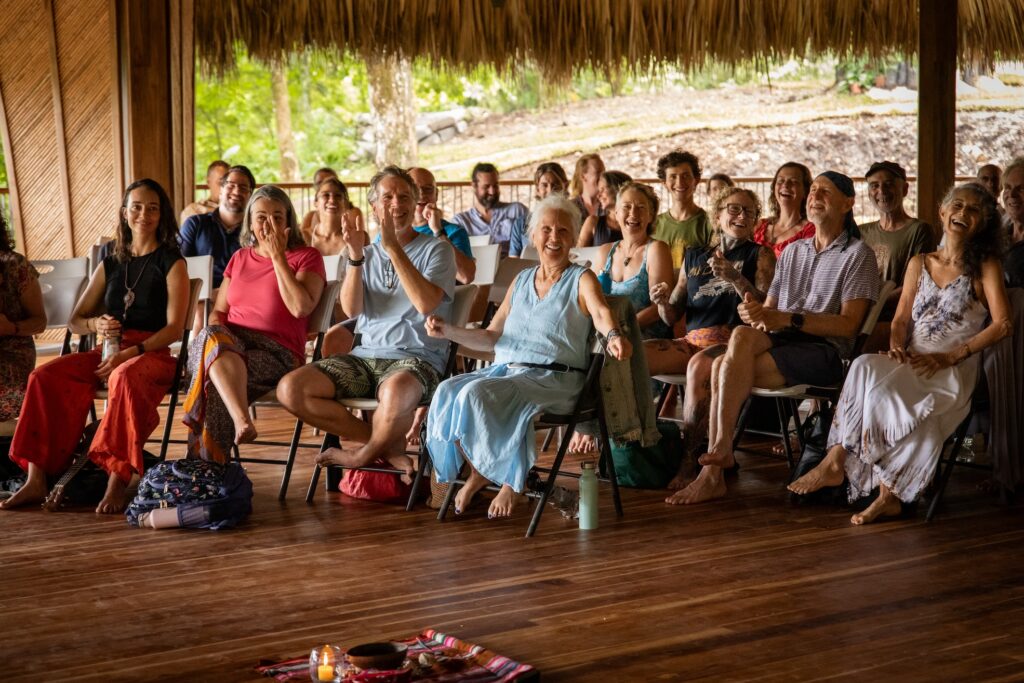
What holds an intentional community together? At Ecovilla San Mateo, an intentional community in San Mateo, Costa Rica, the answer is a Why statement that our neighbours wrote together, and five commitments we practice in everyday life. In this conversation, Zach, one of the community members who has been working on them for the past three years, explains both.
Why a community needs a Why statement
Everyone arrives at Ecovilla San Mateo with their own dream and their own idea of what community is. That’s beautiful, and it’s also exactly why a shared purpose matters.
Many intentional communities that last have a shared dogma, a religion or a charismatic guru. People join because they already follow that way of doing things. Ecovilla San Mateo doesn’t have that. What we share is a broader feeling: “I know there’s a different or better way to be doing things. I want to live closer to nature. I want to be more connected to myself and more connected to other people.”
The Why statement turns that feeling into a common direction. In Zach’s words, it’s the higher purpose that creates coherence and carries us through the challenging times, “because community is not easy.” You can read the full statement on our Our Why page.
Where the five commitments come from
The commitments didn’t appear overnight. A group of neighbours, guided by Zach and Keri Shinn, worked on them for about three years, starting with something called the Social Lab, where they explored the “invisible infrastructure” of a community.
Along the way they tried on many frameworks: the 15 commitments from the Conscious Leadership Group, nonviolent communication, the Ongo practice and the ten principles of Burning Man. From all of that, they chose five commitments as the bedrock layer to start from.
Two things are important to know about them:
- They’re a starting point to learn from. “If in two years from now we have seven commitments and only three of them are from this group, great, we’re really learning.”
- You make them to yourself. Nobody signs anything. The commitments describe how each of us wants to relate to ourselves and others, whether or not other people follow them. As Zach puts it, they’re “really an invitation.”
The five commitments we live by
1. We take responsibility for our own experience
This one is about focusing on our own sphere of influence. When something happens, we try to ask: what can I learn from this, and what is my contribution to it? That’s what lets trust grow between neighbours.
2. We stay curious
On any topic there are always many perspectives, and with neighbours from many different countries and cultures, that’s very real here. Staying curious helps us pump the brakes when we feel the urge to be right instead of understanding. In Zach’s words: “I can be curious about what’s happening instead of sure about what’s happening.”
3. We practice appreciation and generosity
It’s easy to focus on what needs fixing. Taking the time to notice what’s going well, and to appreciate everyone’s efforts, gives a community a lot more energy. Problems still get solved, from a more abundant place.
4. We address tension directly and respectfully
This one helps make sure things don’t fester. When we take responsibility and stay curious, it becomes much easier to start a hard conversation and treat conflict as mutual learning.
5. We remember we’re experimenting
Our tagline here is “good enough for now, safe enough to try.” Bringing together people from all over the world to build an emergent community, without a dogma or a guru, is a big social experiment. This commitment lets us learn by doing, see failures as learning, and not let the perfect be the enemy of the good.
Which commitment asks the most?
Which of these asks the most of people? Zach’s first answer was number four, because addressing tension directly is something most of us haven’t had much practice with. Over the long term, though, he thinks it’s the first one. Taking responsibility for your own experience is the foundation for all the others: “other people can’t make me mad, I am the one that gets mad.”
To bring the commitments from the page into real life, we hold community practice sessions where we build trust and connection and practice them together.
You can’t buy community, but you can build it
Marcelo often says: “You can’t buy community, but you can build it.” Most of us came here because of the idea of community, and the potential this place has is remarkable. Like any worthwhile relationship, whether it’s a marriage, a family or a garden, it takes maintenance, observation, patience and humility. We get out what we put into it.
So what does Zach hope to see three years from now? Something better than he can imagine today. Above all, he hopes Ecovilla truly feels like a community of practice: a place where you can grow and become wiser, because your neighbours are your mirrors, sparring partners and mentors.
Want to experience it yourself?
Read more about daily life in Living in Ecovilla: an intentional community in Costa Rica, or get in touch to come and see it for yourself.